
The Beauty in Imperfection: Lessons from a Destroyed Canvas
Updated: Jun 23
Tucked away in the back room of the Georgia O'Keeffe Museum in Santa Fe, New Mexico, unassumingly nestled in amongst her items of clothing, toiletries, and hair combs, sits a rather weird object that upon first glance, seems out of place and doesn't make a whole lot of sense. It is inexplicably a destroyed painting--a gutted canvas with a gaping hole stretching out to the wooden frame. Beside it is a matter-of-fact museum-offered explanation simply saying that when O'Keeffe finished this painting she so hated it that she destroyed it--cutting out the canvas so that no one else would ever see it.
Museums have a purposeful flow and have been meticulously designed and arranged to compel visitors through the exhibit--each work, each room providing another note in the collective creative symphony of the artist(s). After floating through the O'Keeffe Museum filled with her masterpieces of floral and canyon-inspired brilliance, this gutted canvas stunned me like a slap across the face, stopping me in my tracks. The endless flow of visual symphony that comprise her most famous museum paintings suddenly hit a clanging note, and I was transfixed at its stark contrast, its implied and actual violence, and what it said about her and the creative process. It spoke to me almost as loudly as her completed paintings on glorious display throughout the museum.
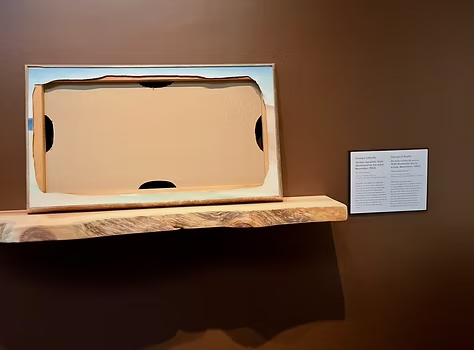
I stood silently taking it in, not sure why I couldn't move on as everyone else seemed to be doing, barely taking notice of it. So I remained, taking in this sad little canvas, and I tried to formulate why I knew this was so important. All of O'Keeffe's paintings and her clothing and personal items and furniture--all of it are tributes to her, creating a well-rounded picture of the legendary artist, but this, THIS sad little destroyed canvas, stirred in me an instant connection to Georgia O'Keeffe as a person, not just an artistic genius. This lone little canvas was a link to Georgia the human, the imperfect struggling creative. Here was evidence that she felt it too--the pressure to be perfect.
One of the benefits of living to be 55 years old is that I have learned that life isn't perfect, and neither are we. Painting isn't perfect; being an artist isn't perfect. Life and art are both processes with successes and failures--but we often learn the most about life and ourselves by our failures, how we handle them, and what we choose to learn from them--our failures shape who are as people and personalities. In looking at that sad canvas, I saw the moment that Georgia O'Keeffe learned something about herself as a person and an artist--that pressure to perform, the pressure of perfection, to live up to one's own often distorted views of ourselves, to live up to how we think others perceive us--I was looking at this moment of realization for her. It's hard not to draw parallels when faced with such tangible evidence of paint-pushed disappointment and canvas-wrapped defeat.
As artists, creative souls, the world loves to celebrate the polished, perfected pieces as a product of what is attainable if we devote ourselves to our craft wholeheartedly, but it doesn't see or recognize the hours and even years of toil and second-guessing and doubt that lie in the layers underneath. Each stroke of paint belies years of struggle to learn techniques and sketching, and each layer contains histories of compositional failures and clouds that just somehow never look quite right no matter how much we fiddle with them. It's only the successes that are celebrated--but I firmly believe that O'Keeffe's masterpieces like Cow's Skull, White Flower No. 1, Cow's Skull with Calico Roses, Red Canna--all of them are made possible by that moment she took a knife to that lone little canvas that now sits apologetically tucked away almost as an afterthought, hidden in the back of her museum like a nagging seed of doubt.
This moment of her obvious frustration should not be seen as a chink in her artistic armor, but rather as evidence of her humanity. Evidence that here, at this moment in time and the days after it, O'Keeffe found the determination to keep going. With this canvas, she learned what not to do, and possibly she learned to give herself more grace with her art, and I found myself feeling very thankful to have seen it. Certainly, O'Keeffe's masterpieces speak to her much-deserved celebration as an artist of vision, clarity of purpose and of place, and of awe-inspiring skill, but this revelatory wreck of a canvas that speaks to her artistic and personal foibles deserves at least some consideration for what it teaches us about what it means to be human.


Comments